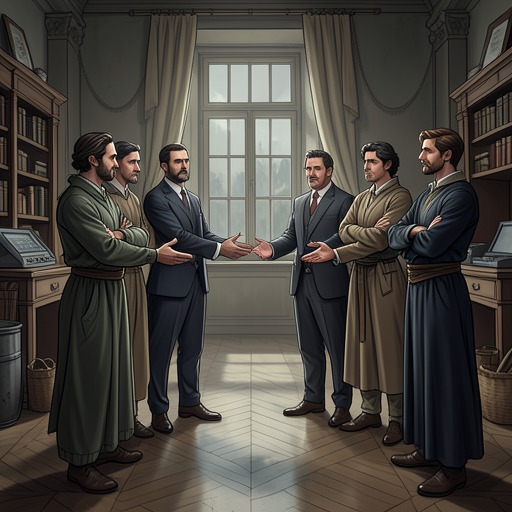
House Frey
A Clash of KingsHouse Frey is a wealthy, numerous, and strategically important bannerman house of House Tully, sworn to the service of Riverrun. Its power rests on both military numbers and the political position of the Twins, but its reputation is compromised by a long history of conditional loyalty. During the War of the Five Kings, House Frey supports Robb Stark only after extracting a marriage promise, making the family a crucial ally whose allegiance is always shadowed by the bargain that purchased it.
Position and Reputation
House Frey is described as powerful, wealthy, and exceptionally numerous, yet it has not always been diligent in performing its obligations to House Tully. When Robert Baratheon met Rhaegar Targaryen on the Trident, the Freys did not arrive until the battle had ended. Lord Hoster Tully consequently called Lord Walder “the Late Lord Frey,” turning a military delay into a lasting family epithet and a public measure of the house’s reliability.
That history gives House Frey a distinctive place among the noble houses of the Riverlands. It is formally bound by feudal service, but its conduct suggests that formal allegiance does not automatically produce timely action. The house possesses enough wealth and manpower to matter greatly, yet its political value is inseparable from the suspicion that it will calculate the safest or most profitable moment to commit itself.
The Marriage Bargain with Robb Stark
Lord Walder Frey agrees to support the cause of the King in the North only after Robb Stark promises to marry one of his daughters or granddaughters when the war is over. The agreement makes military assistance the price of a dynastic settlement. House Frey therefore enters Robb’s coalition through a transaction that joins battlefield service to family advancement rather than through a simple declaration of shared cause.
Robb later reminds Ser Cleos that Lord Walder pledged both his own support and that of House Frey. Many Frey cousins and uncles rode with Robb in the Whispering Wood, but Ser Cleos fought beneath the lion banner and was consequently treated as a Lannister rather than as a Frey. The distinction shows how House Frey’s collective obligations coexist with individual political choices: family connection can establish a claim, but a man’s chosen banner determines how his loyalty is judged.
The marriage promise also makes House Frey a structural dependency within the northern alliance. Robb’s military victories do not erase the obligation he incurred at the Twins. His kingship is strengthened by Frey swords, but it is simultaneously constrained by the need to preserve Lord Walder’s faith. The alliance thus turns kinship into both support and pressure.
Family Scale and Political Leverage
Lord Walder Frey is ninety-one years old and has recently taken an eighth wife, a girl seventy years younger than himself. The striking age difference emphasizes not merely personal eccentricity but the family’s extraordinary capacity for continued expansion. The Frey household is so large that it is said Lord Walder is the only lord in the Seven Kingdoms who could field an army out of his breeches, an image that converts reproduction into military potential and political capital.
The family’s size produces a dense network of sons, grandsons, cousins, uncles, marriages, wards, and military obligations. Ser Stevron is heir to the Twins; Ser Ryman is Stevron’s eldest son, while Black Walder is another of Ryman’s sons. Other Freys are distributed across the wider conflict: Ser Ryman, Black Walder, and others serve with Robb in the west; Martyn provides valuable scouting; and Ser Perwyn helps bring Catelyn Stark safely to Renly Baratheon. These individual services allow House Frey to demonstrate usefulness across several theaters while keeping its family presence politically visible.
The house’s power also appears in the exchange between Catelyn Stark and Edmure Tully. Edmure argues that the Freys fought bravely in the Whispering Wood and that old Ser Stevron died at Oxcross. He points to Robb’s betrothal to one of Lord Walder’s daughters, Roose Bolton’s marriage to another, and the fostering of two of Lord Walder’s grandsons at Winterfell. In his view, these interlocking ties give the Freys strong reasons not to betray the alliance: Bolton needs Frey men, and the wards can become hostages if necessary.
Conduct, Captivity, and the Limits of Alliance
House Frey’s mixed identity is exposed through Ser Cleos. Robb releases him from his cell only to carry a message to Cersei Lannister in King’s Landing under a peace banner, escorted by thirty of Robb’s best men. Robb explicitly warns that this is not freedom: Ser Cleos must deliver the message, return with the queen’s reply, and resume his captivity. He gives the pledge on his honor as a knight, while Ser Edmure Tully warns that the whole realm has heard the vow and will know him forsworn if he fails to return.
The episode separates blood relation from political allegiance. Lord Walder’s pledge and the service of numerous Freys do not protect Ser Cleos from being classified as a Lannister because he chose to fight beneath the lion banner. House Frey can be an ally as a corporate body while one of its members becomes an enemy through personal allegiance. The arrangement also shows how promises operate as practical instruments of power: honor, public witness, captivity, and the threat of disgrace are combined to make a reluctant envoy useful.
When Ser Cleos later brings the queen’s answer, the violence surrounding his party demonstrates how fragile such negotiated protections are. Edmure Tully explains that the men who came with him had surrendered their weapons and received freedom within the castle, but after three nights they attempted to free the Kingslayer. They killed guards, used wire to open Jaime Lannister’s cell, and employed an impersonation of Edmure’s voice to order the River Gate opened. Edmure consequently calls them false envoys and has them hanged. The incident does not establish House Frey’s guilt, but it places Frey-associated diplomacy within an atmosphere where peace banners, sworn promises, and hospitality can all be overturned by concealed violence.
Narrative Significance
House Frey embodies the political logic of the riverlands: survival depends on networks, crossings, marriages, hostages, and carefully measured commitments. Its wealth and numbers make it too important to dismiss, while its delayed service makes trust impossible without safeguards. The house’s alliance with Robb is therefore not a stable moral bond but a continuing negotiation in which military assistance, dynastic honor, and coercive leverage reinforce one another.
The Freys also provide a contrast to simpler ideas of feudal loyalty. A pledge may be sincere, yet still be purchased; family may create obligations, yet not erase the consequences of an individual’s banner; wards may be children in one context and hostages in another. Through House Frey, the story presents political order as a field of overlapping rules in which vows, kinship, reputation, and force compete to determine what allegiance means. Their abundance is their strength, but it is also the source of their ambiguity: a house large enough to field an army can place swords everywhere, and therefore make every alliance more valuable, more complicated, and more difficult to trust.